
Daily Reading
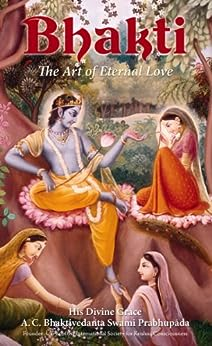
Bhakti: The Art of Eternal Love
Six Features of Pure Bhakti
Next Rūpa Gosvāmī gives six unique features of pure devotional service.
- Pure devotional service brings immediate relief from all kinds of material distress.
- Pure devotional service is the beginning of all auspiciousness.
- Pure devotional service automatically puts one in transcendental pleasure.
- Pure devotional service is rarely achieved.
- Those in pure devotional service deride even the conception of liberation.
- Pure devotional service is the only means to attract Kṛṣṇa. Kṛṣṇa is all-attractive, but pure devotional service attracts even Him. This means that pure devotional service is even transcendentally stronger than Kṛṣṇa Himself, because it is Kṛṣṇa’s internal potency.
- Kṛṣṇa Consciousness Brings Relief from All Material Distress
In the Bhagavad-gītā, the Lord says that one should surrender unto Him, giving up all other engagements. The Lord also gives His word there that He will protect surrendered souls from the reactions of all sinful activities. Śrīla Rūpa Gosvāmī says that the distresses from sinful activities are due both to the sins themselves and to sins committed in our past lives. Generally, one commits sinful activities due to ignorance. But ignorance is no excuse for evading the reaction – distresses. Sinful activities are of two kinds: those which are mature and those which are not mature. The sinful activities for which we are suffering at the present moment are called mature. The many sinful activities stored within us for which we have not yet suffered are considered immature. For example, a man may have committed criminal acts but not yet been arrested for them. Now, as soon as he is detected, arrest is awaiting him. Similarly, for some of our sinful activities we are awaiting distresses in the future, and for others, which are mature, we are suffering at the present moment.
In this way there is a chain of sinful activities and their concomitant distresses, and the conditioned soul is suffering life after life due to these sins. He is suffering in the present life the results of sinful activities from his past life, and he is meanwhile creating further sufferings for his future life. Mature sinful activities are exhibited if one is suffering from some chronic disease, if one is suffering from some legal implication, if one is born in a low and degraded family, or if one is uneducated or very ugly.
There are many results of past sinful activities for which we are suffering at the present moment, and we may be suffering in the future due to our present sinful activities. But all of these reactions to sinful deeds can immediately be stopped if we take to Kṛṣṇa consciousness. As evidence for this, Rūpa Gosvāmī quotes a verse from the Śrīmad-Bhāgavatam (11.14.19). This verse is in connection with Lord Kṛṣṇa’s instruction to Uddhava, where He says, “My dear Uddhava, devotional service unto Me is just like a blazing fire that can burn into ashes unlimited fuel supplied to it.” The purport is that as the blazing fire can burn any amount of fuel to ashes, so devotional service to the Lord in Kṛṣṇa consciousness can burn up all the fuel of sinful activities. For example, in the Gītā Arjuna thought that fighting was a sinful activity, but Kṛṣṇa engaged him on the battlefield under His order, and so the fighting became devotional service. Therefore, Arjuna was not subjected to any sinful reaction.
Śrīla Rūpa Gosvāmī quotes a verse from the Third Canto of Śrīmad-Bhāgavatam (3.33.6), in which Devahūti addresses her son, Kapiladeva, an incarnation of Kṛṣṇa who taught a type of yoga called sāṅkhya, and says, “My dear Lord, there are nine different kinds of devotional service, beginning from hearing and chanting. Anyone who hears about Your pastimes, who chants about Your glories, who offers You obeisances, who thinks of You and, in this way, executes any of the nine kinds of devotional service – even if he is born in a family of dog-eaters [the lowest grade of mankind] – becomes immediately qualified to perform sacrifices.” As such, how is it possible that anyone actually engaged in devotional service in full Kṛṣṇa consciousness has not become purified? It is not possible. One who is engaged in Kṛṣṇa consciousness and devotional service has without doubt become freed from all contaminations of material sinful activities. Devotional service therefore has the power to actually nullify all kinds of reactions to sinful deeds. A devotee is nevertheless always alert not to commit any sinful activities; this is his specific qualification as a devotee. Thus the Śrīmad-Bhāgavatam states that by performing devotional service a person who was born even in a family of dog-eaters may become eligible to take part in the performance of the ritualistic ceremonies recommended in the Vedas. It is implicit in this statement that a person born into a family of dog-eaters is generally not fit for performing yajña, or sacrifice. The priestly caste in charge of performing these ritualistic ceremonies recommended in the Vedas is called the brāhmaṇa order. Unless one is a brāhmaṇa, he cannot perform these ceremonies.