
Daily Reading
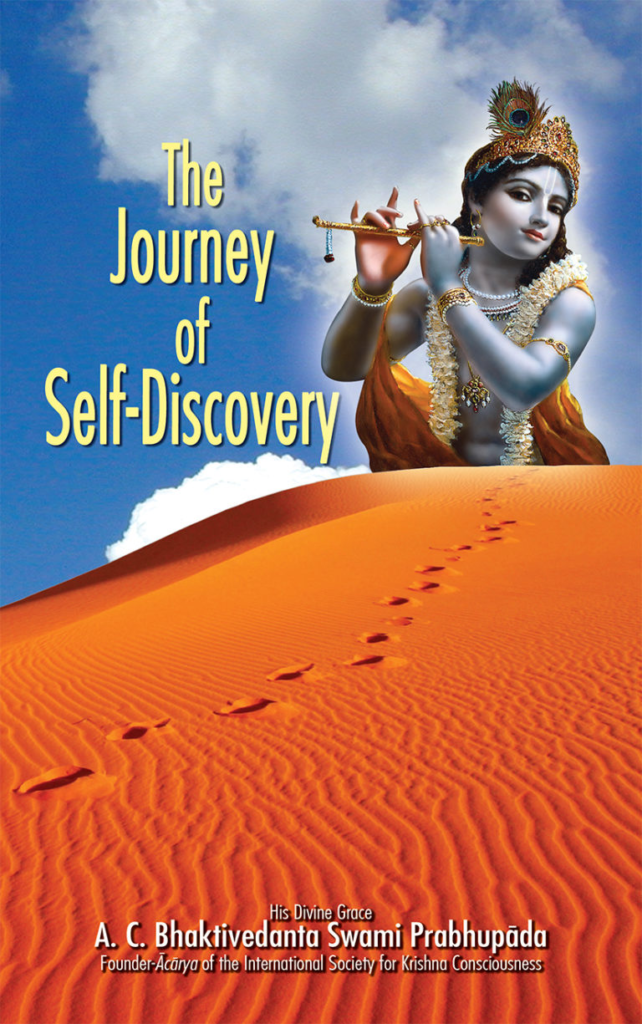
The Journey Of Self Discovery
CHAPTER SIX
Material Problems, Spiritual Solutions
Focus for Global Unity
December 1969: Speaking in Boston before the International Student Society, Śrīla Prabhupāda provides a practical, simple, yet profound solution for world peace and harmony. Noting the increasing number of flags at the United Nations building in New York, he states that internationalism is failing because “your international feeling and my international feeling are overlapping and conflicting. We have to find the proper center for our loving feelings. … That center is Kṛṣṇa.”
Thank you very much for participating with us in this Kṛṣṇa consciousness movement. I understand that this society is known as the International Student Society. There are many other international societies, such as the United Nations. So the idea of an international society is very nice, but we must try to understand what the central idea of an international society should be.
If you throw a stone into the middle of a pool of water, a circle will expand to the limit of the bank. Similarly, radio waves expand in a circle, and when you capture the waves with your radio you can hear the message. In the same way, our loving feeling can also expand.
At the beginning of our life, we simply want to eat. Whatever a small child grabs, he wants to eat. He has only personal interest. Then, when the child grows a little, he tries to participate with his brothers and sisters: “All right. You also take a little.” This is an increase in the feeling of fellowship. Then, as he grows up, he begins to feel some love for his parents, then for his community, then for his country, and at last for all nations. But unless the center is right, that expansion of feeling – even if it is national or international – is not perfect.
For example, the meaning of the word national is “one who has taken birth in a particular country.” You feel for other Americans because they are born in this country. You may even sacrifice your life for your countrymen. But there is a defect: If the definition of national is “one who is born in a particular country,” then why are the animals born in America not considered Americans? The problem is that we are not expanding our feelings beyond the human society. Because we don’t think animals are our countrymen, we send them to the slaughterhouse.
So the center of our national feeling or our international feeling is not fixed on the proper object. If the center is right, then you can draw any number of circles around that center and they’ll never overlap. They’ll simply keep growing, growing, growing. They’ll not intersect with one another if the center is all right. Unfortunately, although everyone is feeling nationally or internationally, the center is missing. Therefore your international feeling and my international feeling, your national feeling and my national feeling, are overlapping and conflicting. So we have to find the proper center for our loving feelings. Then you can expand your circle of feelings and it will not overlap or conflict with others’.
That center is Kṛṣṇa.
Our society, the International Society for Krishna Consciousness, is teaching the people of all countries that the center of their affection should be Kṛṣṇa. In other words, we are teaching people to be mahātmās. You may have heard this word mahātmā before. It is a Sanskrit word that is applied to a person whose mind is expanded, whose circle of feelings is very much expanded. This is a mahātmā. Mahā means “big” or “great,” and ātmā means “soul.” So he who has expanded his soul very wide is called a mahātmā.
The Bhagavad-gītā [7.19] gives a description of the person who has expanded his feelings very wide:
bahūnāṁ janmanām ante
jñānavān māṁ prapadyate
vāsudevaḥ sarvam iti
sa mahātmā su-durlabhaḥ
The first idea in this verse is that one can become a mahātmā only after many, many births (bahūnāṁ janmanām ante). The soul is transmigrating through many bodies, one after another. There are 8,400,000 different species of life, and we evolve through them until at last we come to the human form of life. Only then can we become a mahātmā. This is why Kṛṣṇa says bahūnāṁ janmanām ante: “After many, many births one may become a mahātmā.”
In the Śrīmad-Bhāgavatam there is a similar verse. Labdhvā su-durlabham idaṁ bahu-sambhavānte: “After many, many births you have achieved a human body, which is very difficult to get.” This human form of life is not cheap. The bodies of cats and dogs and other animals are cheap, but this human form is not. After being born in at least 8,000,000 different species, we get this human form. So the Bhāgavatam and the Bhagavad-gītā say the same thing. All Vedic literatures corroborate one another, and the person who can understand them doesn’t find any contradiction.