
Daily Reading
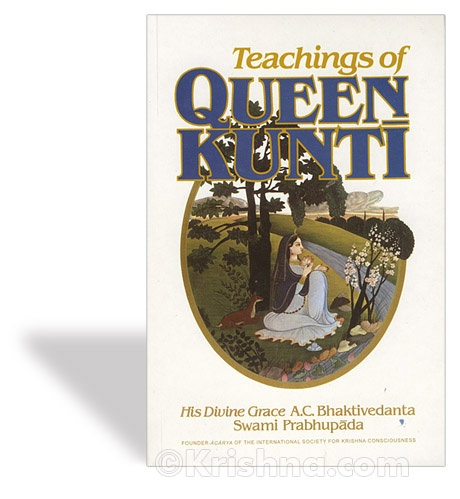
Teachings of Queen Kuntī
The Master of the Senses
yathā hṛṣīkeśa khalena devakī
kaṁsena ruddhāti-ciraṁ śucārpitā
vimocitāhaṁ ca sahātmajā vibho
tvayaiva nāthena muhur vipad-gaṇāt
O Hṛṣīkeśa, master of the senses and Lord of lords, You have released Your mother, Devakī, who was long imprisoned and distressed by the envious King Kaṁsa, and me and my children from a series of constant dangers.
Śrīmad-Bhāgavatam 1.8.23
Devakī, the mother of Kṛṣṇa and sister of King Kaṁsa, was put into prison along with her husband, Vasudeva, because the envious King was afraid of being killed by Devakī’s eighth son (Kṛṣṇa). The King killed all the sons of Devakī who were born before Kṛṣṇa, but Kṛṣṇa escaped the danger of child-slaughter because He was transferred to the house of Nanda Mahārāja, Lord Kṛṣṇa’s foster father. Kuntīdevī, along with her children, was also saved from a series of dangers. But Kuntīdevī was shown far more favor because Lord Kṛṣṇa did not save the other children of Devakī, whereas He saved the children of Kuntīdevī. This was done because Devakī’s husband, Vasudeva, was living, whereas Kuntīdevī was a widow and there was none to help her except Kṛṣṇa. The conclusion is that Kṛṣṇa bestows more favor upon a devotee who is in greater dangers. Sometimes He puts His pure devotees in such dangers because in that condition of helplessness the devotee becomes more attached to the Lord. The more the attachment is there for the Lord, the more success is there for the devotee.
Devakī, the devotee who became the mother of Kṛṣṇa, was not an ordinary woman. After all, who can become the mother of the Supreme Personality of Godhead? Kṛṣṇa agrees to become the son only of the most advanced devotee. In their previous lives, Devakī and her husband underwent severe austerities, and when Kṛṣṇa therefore appeared before them, wanting to give them a benediction, they told Him that they wanted a son like God. But where can there be another person equal to God? That is not possible. God is asamaurdhva; that is, no one can be equal to or greater than Him. There cannot be any competition. One cannot say, “I am God, you are God, he is God, we are all God.” No. One who says this is a dog, not God, for God is great, and He has no competitor. No one is equal to Him; everyone is lower. Ekale īśvara kṛṣṇa āra saba bhṛtya: the only master is Kṛṣṇa, God, and everyone else is His servant, including even great demigods like Brahmā, Viṣṇu, and Śiva, not to speak of others. Śiva-viriñci-nutam. In the śāstra, the Vedic scriptures, it is said that Lord Kṛṣṇa is offered respect even by Lord Śiva and Lord Brahmā, the topmost demigods.
Above the human beings there are demigods. As we human beings are above the lower animals, above us there are demigods, the most important of whom are Lord Brahmā and Lord Śiva. Lord Brahmā is the creator of this universe, Lord Śiva is its destroyer, and Lord Viṣṇu, who is Kṛṣṇa Himself, is its maintainer. For the maintenance of this material world there are three guṇas, or modes of material nature – sattva-guṇa (the mode of goodness), rajo-guṇa (the mode of passion), and tamo-guṇa (the mode of ignorance). Lord Viṣṇu, Lord Brahmā, and Lord Śiva have each taken charge of one of these modes – Lord Viṣṇu of sattva-guṇa, Lord Brahmā of rajo-guṇa, and Lord Siva of tamo-guṇa. Yet these three controllers are not under the influence of the guṇas. Just as the superintendent of a jail is not a prisoner but the controlling officer, so Lord Śiva, Lord Viṣṇu, and Lord Brahmā control these three guṇas and are not under the control of the guṇas.
But above all others, the supreme controller is Kṛṣṇa, who is known as Hṛṣīkeśa. The word hṛṣīka means “senses.” We are enjoying our senses, but ultimately the controller of the senses is Kṛṣṇa. Consider my hand, for example. I claim, “This is my hand. I can fight you with a good fist.” I am very much proud. But I am not the controller; the controller is Kṛṣṇa, because if He withdraws my hand’s power to act, the hand will be paralyzed. Although I claim, “It is my hand, and I shall use it,” when it is paralyzed I cannot do anything. Therefore, I should understand that although I possess this hand by the grace of Kṛṣṇa, I am not its controller. This is Kṛṣṇa consciousness.