Daily Reading
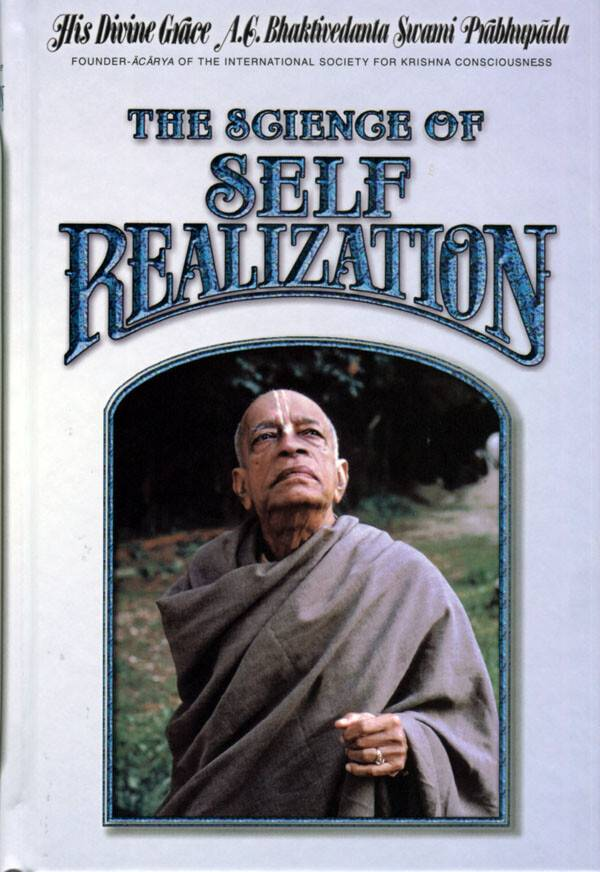
The Science of Self-Realization
CHAPTER FIVE
Practicing Yoga in the Age of Quarrel
Superconsciousness
“The Supersoul, being present within everyone, situated everywhere, is conscious of every existence. The theory that the soul and the Supersoul are one is not acceptable, because the individual soul’s consciousness cannot act in superconsciousness. This superconsciousness can only be achieved by dovetailing individual consciousness with the superconsciousness; and this dovetailing process is called surrender, or Kṛṣṇa consciousness.”
Kṛṣṇa consciousness is the highest yoga performance by trained devotional yogis. The yoga system, as is stated in the standard yoga practice formula given by Lord Kṛṣṇa in the Bhagavad-gītā, and as recommended in the Patañjali yoga discipline, is different from the nowadays-practiced haṭha-yoga as is generally understood in the Western countries.
Real yoga practice means to control the senses and, after such control is established, to concentrate the mind on the Nārāyaṇa form of the Supreme Personality of Godhead, Śrī Kṛṣṇa. Lord Kṛṣṇa is the original Absolute Personality, the Godhead, and all the other Viṣṇu forms – with four hands, decorated with conch, lotus, club, and wheel – are plenary expansions of Kṛṣṇa.
In the Bhagavad-gītā it is recommended that we should meditate upon the form of the Lord. For practicing concentration of the mind, one has to sit down in a secluded place sanctified by a sacred atmosphere, and the yogi should observe the rules and regulations of brahmacarya – to live a life of strict self-restraint and celibacy. No one can practice yoga in a congested city, living a life of extravagance, including unrestricted sex indulgence and adultery of the tongue.
We have already stated that yoga practice means controlling the senses, and the beginning of controlling the senses is to control the tongue. You cannot allow the tongue to take all kinds of forbidden food and drink, and at the same time improve in the practice of yoga. It is a very regrettable fact that many stray, unauthorized so-called yogis now come to the West and exploit the leaning of the people toward yoga. Such unauthorized yogis even dare to say publicly that one can indulge in drinking and at the same time practice meditation.
Five thousand years ago, in the Bhagavad-gītā dialogue, Lord Kṛṣṇa recommended yoga practice to His disciple Arjuna, but Arjuna flatly expressed his inability to follow the stringent rules and regulations of yoga. One should be practical in every field of activity. One should not waste his valuable time simply in practicing some gymnastic feats in the name of yoga. Real yoga is to search out the four-handed Supersoul within one’s heart and to see Him perpetually in meditation. Such continued meditation is called samādhi. If, however, one wants to meditate upon something void or impersonal, it will require a very long time to achieve anything by yoga practice. We cannot concentrate our mind on something void or impersonal. Real yoga practice is to fix the mind on the person of the four-handed Nārāyaṇa who dwells in everyone’s heart.
Sometimes it is said that by meditation one will understand that God is seated within one’s heart always, even when one does not know it. God is seated within the heart of everyone. Not only is He seated in the heart of the human being, but He is also within the hearts of the cats and dogs. The Bhagavad-gītā certifies this with the declaration that Īśvara, the supreme controller of the world, is seated in the heart of everyone. He is present not only in everyone’s heart, but also within the atoms. No place is vacant; no place is without the presence of the Lord.
The feature of the Lord by which He is present everywhere is called the Paramātmā. Ātmā means the individual soul, and Paramātmā means the individual Supersoul. Both ātmā and Paramātmā are individual persons. The difference between them, however, is that the ātmā, or soul, is present only in one particular place, whereas the Paramātmā is present everywhere.
In this connection, the example of the sun is very nice. An individual person may be situated in one place, but the sun, even though a specific individual entity, is present over the head of every individual person. In the Bhagavad-gītā this is very nicely explained. Therefore, even though the qualities of all entities, including the Lord, are equal, the Supersoul is different from the individual soul by quantity of expansion. The Lord, or Supersoul, can expand Himself into millions of different forms, while the individual soul cannot do so.